Every ceiling job should start with a clear target. What are you trying to stop? How is it getting into your room? This section breaks down the main service paths we use, so you can see what’s happening behind the finished surface.
Airborne Noise Control
Airborne noise is sneaky. You might not hear it as “loud,” but it’s constant. You catch words. You recognize the show. It pulls your attention even when you try to ignore it. For this, soundproofing ceiling systems usually rely on mass and damping. Dense layers block more energy. Damping reduces vibration between layers, so the ceiling doesn’t behave like a speaker.
We also focus hard on sealing. Small gaps around recessed lights, ceiling edges, and pipe penetrations can leak a surprising amount of sound. If those leaks stay open, even expensive materials underperform.
Impact Noise Reduction
Impact noise is the classic Santa Monica headache. It’s the stomp, the heel strike, the furniture scrape. This noise travels through structure, not just air. That’s why simple add-on layers often disappoint. To seriously reduce impact noise, you usually need decoupling. That means creating separation so vibration has a harder time transferring into your ceiling.
A well-designed system won’t make a busy upstairs apartment silent. But it can take the sharpness out of the sound. It can make the noise feel distant instead of aggressive. For soundproofing ceiling apartment projects, that difference is huge. It can turn a space from “I can’t live like this” into “I can breathe again.”
High-Performance Materials & Assemblies
There is no magic product. The win comes from a tested assembly. That can include Mass Loaded Vinyl, damping compounds between layers, and isolation hardware that breaks vibration paths. The design depends on your building and your constraints. Ceiling height matters. Lighting matters. Access to HVAC and sprinklers matters.
We also consider weight and support. Not every ceiling can carry the same load without smart planning. If you’re comparing acoustical ceiling contractors, look for the ones who talk about structure, not just “adding another layer.” That’s where real performance comes from.
Drop Ceiling Soundproofing
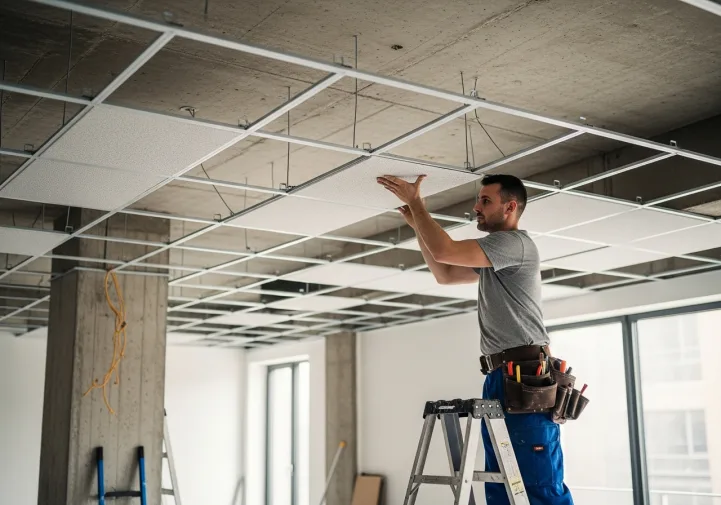
Drop ceilings can be a great opportunity if they’re built the right way. They already create a cavity, and that space can help you control noise. The mistake is treating it like a cosmetic ceiling only. If the grid is loose, if tiles are thin, or if gaps are left open, sound slips through and the room stays loud. The fix usually involves upgrading the system as a whole, not swapping a single tile.
When people call acoustic ceiling installation contractors, this is often what they want: a ceiling that looks clean, stays accessible for utilities, and actually reduces noise in real life.
A high-performing drop ceiling plan may include heavier tiles, added mass above the grid, and strategic absorption in the cavity. Then we seal the perimeter and address penetrations. That last part is huge. If air can pass, sound can pass.